
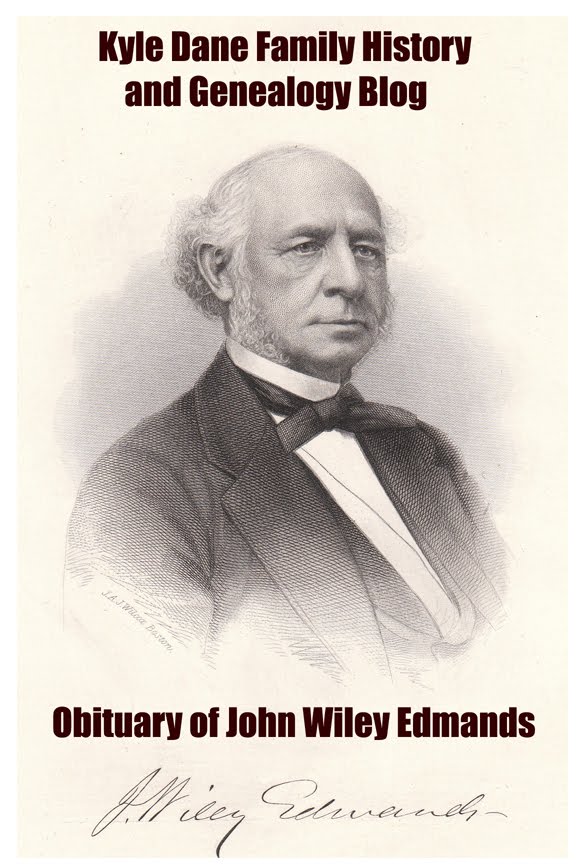
Found among my grandfather's belongings was a typewritten summary of several tributes and remembrances of my 3X great grandfather, John Wiley Edmands. I am sure that some of these writings were published but I haven't determined where yet. I will credit them if/when I determine where they were published.
This one is simply titled “Obituary”:
The Hon. J. Wiley Edmands died of heart disease at four o’clock yesterday morning at his home in Newton. The diseases which finally proved fatal had troubled him for many years, and that his life should close in this way has been expected. He was born in this city March 1, 1809 (his father, of the firm of Lincoln & Edmands, being one of the leading booksellers of the city), was educated at the grammar school, and entered the English high school when it was founded in 1821. After graduating from school he entered the employ of A. & A. Lawrence, and his marked business capacity brought him into the full confidence of the senior member of the firm, Amos Lawrence. He was gradually promoted, till 1830, when he was made a member of the firm, and soon became the real guide of its policy. In 1843 he retired from the firm, and for several years afterward, was interested in the Maverick woolen mills in Dedham. In the fall election of 1852 he was elected to Congress, and served for the term from March 4, 1853, to 1855, declining a reelection. He was not politically ambitious, and preferred his business to all political offices. Such offices as he accepted were not gained by any self-seeking. He was a member of the whig party at the time he went to Washington. A fellow-member of the Massachusetts delegation was the Hon. Samuel H. Walley. Mr. Edmands was often mentioned by his friends for the prominent political positions, but the only one he accepted was that of the Presidential elector from the seventh congressional district for the election of 1868.
Mr. Edmands became treasurer of the Pacific mills of Lawrence in 1855, and has occupied that position ever since. It was here that he made the reputation which has placed him foremost among the business men of New England and has given the Pacific mills so favorable a name in this country and abroad. He was associated with other gentlemen of foresight and sagacity, and it was here that he became most widely known. At the outbreak of the civil war in 1861 Mr. Edmands was an active worker. He gave his time, influence and money to the support of the government, and has been a strong republican ever since the organization of the party. He was prominently mentioned for Secretary of the Treasury for President Lincoln's cabinet.
Mr. Edmands had wide business relations, and was connected with many financial institutions. He was a director in the Arkwright Mutual Fire Insurance Company, of the Massachusetts Hospital Life Insurance Company and of the Suffolk Bank, and was vice-president of the Provident Institution for Savings. He was for some time director of the Ogdensburg Railroad, and had been the treasurer. He was also treasurer of the Eye and Ear Infirmary. From his well-known ability and cordial, sympathizing nature his advice was frequently sought in business matters, and he was ever ready to be helpful. Within a few years he had suffered from business reverses.
He was a benefactor of the city of Newton, where he lived, his most important gift being that for the Newton free library, ten thousand dollars for the building and five thousand dollars for books. He was married early in life to Miss Rebecca A. Cushing, daughter of Joseph Cushing of Baltimore. She and his eight sons all survive him. The funeral will take place in Newton on Saturday.
This second one is titled "J. Wiley Edmands":
We have to record the death of one of our community whose tremendous activities could be aptly compared to those of a mighty Corliss engine, and whose extinction was as sudden as the arrest of the engine in the midst of its most efficient work. If mind could ever be compared with matter the simile might be made still closer, for Mr. Edmands was the moving power of the most colossal of the manufacturing establishments of New England. But the power of the engine ceased with the failure of the fuel which drives it, while the power of the great human motors lasts for all time.
There is no need to speak of the ability displayed by Mr. Edmands in the more immediate sphere of his duty as the treasurer and, according to the New England custom, the responsible head of the Pacific mills; or of the financial and manufacturing skill which enabled him to bring an establishment that had sunk almost into hopeless bankruptcy to its present position of unequalled success - our proudest example of industrial and administrative achievement. But few can have an adequate conception of the intellectual strain required to keep in discipline an industrial army of over four thousand persons; of the nervous exhaustion incident to making personally, and on his sole responsibility, the thousands and tens of thousands of bargains involved in purchasing the seven or eight million dollars' worth of raw materials required f the annual supply of his mill; of the command of will which could decide instantly on a purchase of a million dollars, and could reject or accept, with hardly a moment's apparent thought, a hundred commercial offers in a day. This was Mr. Edmands's daily work, occupying hardly more than four concentrated hours, which were still so elastic as to leave room for consultation on friendly or public questions. Vast as was this work, upon which we need dwell no further, it was but part of the work which gave him his fully recognized position as first among the business men of our city. His influence was predominant in the banking, insurance and trust companies with which he was connected, for he had the rare combination of mastery of the details and a comprehension of the general principles of business. The broad scope of his intellect was manifested in his rare intelligence upon the economical questions which he at the foundation of national development. A cadet of the famous house of A. & A. Lawrence, subsequently a partner, and still later executor, of Mr. Abbott Lawrence, he was the direct descendant and representative of the illustrious school, the Lowells, Appletons, Jacksons, Lawrence, who laid the foundation of New England's prosperity, and made Boston what it is - the headquarters of a vast manufacturing industry - the man who inspired Webster and gave Henry Clay his arguments for an American system. He partook of the sentiments of the New England school of national economy, as compared with the more ultra Pennsylvania school; being moderate and conservative in his views of protection, and believing that the least protective duties should be imposed which would suffice to make our national industry independent. His position fo several recent years as president of the National Association of Wool Manufacturers brought his knowledge and judgment in economical questions into direct requisition and enabled him to exert a powerful influence upon national legislation. It is through his advocacy of equal protection to the agricultural and manufacturing interests that his name is as well known in the West as in New England.
Mr. Edmands was not less known for the part which he has always taken in national and political questions. He was a member of Congress for one term only, having declined a reelection and many subsequent offers of nomination. But in his brief term of office he was distinguished as a member of financial committees. Still maintaining his interest in national questions, it is probable that no other person in New England, out of office, has been so much consulted by the New England republican senators and representatives in Congress. He was president of the first great convention, that at Boston, which nominated General Grant for the Presidency, and was one of the Presidential electors. He was prominently mentioned by influential business men as Secretary of the Treasury in President Grant's first administration, and subsequently by leading men of the West for the position of minister to England, - in both cases without his knowledge. The republican party has suffered the loss of one whose counsels were always wise, and whose devotion to it both in time and money was inspired only by patriotism.
We can but allude to Mr. Edmands's services in institutions of the public charity or education. The same devotion which he gave to his mill he gave without price to one of the most admirable of our charities - the Eye and Ear Infirmary - of which he was from its foundation the treasurer and business manager, through his financial skill and the generous and unpaid services of its surgeons, relieving as many as seven thousand patients in a year. Of the public library in Newton he was the principal benefactor, and to the humble orphan school of his village the most generous giver of what was more valuable to him and them than money, his precious time.
How much he valued knowledge is shown by his address at the anniversary of the Boston high school, and address whose sentiments and style have been often referred to as the best illustration of the education which the Boston common schools can give.
The most social of men, Mr. Edmands shunned fashionable society. His delight was to close his busy day under the shade of the trees which his own hand had planted at his country-seat at Newton, which Downing might have envied; to pay his regular daily visit to his aged mother, who lived near him; to fill his accustomed place in the church where he worshipped; to be a kind neighbor and good citizen, and, above all, to drink from the cup of domestic happiness which Providence had filled for him to the brim.
We cannot point to the leading business man of our community who has just passed away as a monument of personal financial success, for the devotion to the interests of others in his keeping left little time for his own, but we can point to the most precious of possessions, an unspotted name and an example of devotion almost heroic to business and public trusts.


